What Professional Security Planners Understand About Risk That Most Homeowners Don’t
Updated: Jun 1

BEFORE YOU START
When most homeowners think about security, they often focus on individual threats.
A break-in. A storm. A fire. A specific event they hope to prevent.
Professional security planners typically approach the problem differently.
Rather than focusing on a single threat, they focus on risk.
Risk considers not only what could happen, but also how likely it is to occur, how severe the consequences might be, and what practical steps can reduce vulnerability without creating unnecessary complexity.
This perspective often leads to better decisions because resources can be directed toward the areas that matter most.
Before evaluating your own preparedness and security measures, take a moment to think about the risks your household faces.
Ask yourself:
Which disruptions are most likely to affect your household?
What events would create the greatest impact if they occurred?
Are your current preparations aligned with realistic risks?
Have you invested more heavily in unlikely scenarios than common ones?
What vulnerabilities would be most disruptive to daily life?
The answers often reveal that effective security is not built around fear. It is built around understanding priorities and making informed decisions about where to focus time, effort, and resources.
As you read through this guide, focus on the principles of risk assessment and practical preparedness. The goal is not to eliminate every possible threat. The goal is to reduce the likelihood and impact of the disruptions that matter most to your household.
Most homeowners think about security only after something makes them uncomfortable.
A suspicious vehicle in the neighborhood.
A package theft.
A storm-related outage.
A news story that hits too close to home.
At that point, protection becomes reactive.
People start buying cameras. Floodlights. Smart locks. Alarm subscriptions. Motion detectors.
And while these tools can absolutely improve security, professionals approach protection very differently.
They begin with risk.
Not fear. Not gadgets. Not marketing claims.
Risk.
At Aegis Continuity, we believe understanding that distinction changes everything about how households should approach modern home security.
Because professional security planning is not about creating anxiety.
It is about reducing vulnerability while improving continuity.
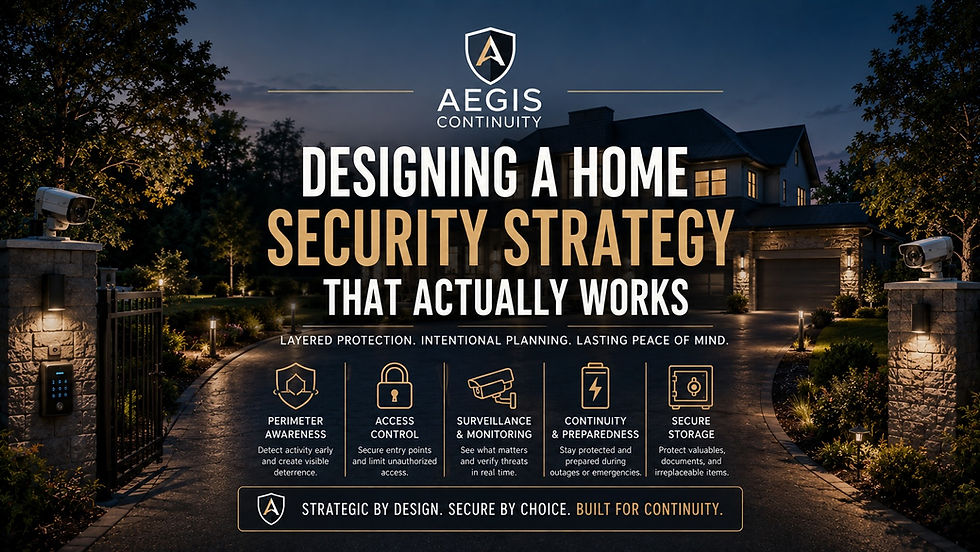
Professionals Think in Layers, Not Products
One of the biggest differences between homeowners and professional planners is how they define security itself.
Most homeowners think in terms of individual products.
“I need a camera.”
“I should buy a smart lock.”
“I probably need motion lights.”
Professionals think in systems.
How early can movement be detected?
What areas have limited visibility?
Where are the vulnerable access points?
What systems continue functioning during outages?
How quickly can occupants respond if something happens?
These questions create layered protection rather than isolated upgrades.
This matters because no individual device creates security on its own.
A camera records activity.
A lock slows access.
Lighting improves visibility.
A driveway alert creates early awareness.
A backup battery maintains continuity.
But together, these systems create resilience.
This is why layered planning consistently outperforms impulsive gadget accumulation.
Risk Is About Probability and Consequence
One reason professional security planning often feels calmer than consumer marketing is because it focuses on probability rather than fear.
Professionals ask two primary questions:
How likely is a problem to occur?
And:
What happens if it does?
That second question is often overlooked by homeowners.
Many people focus entirely on intrusion prevention while ignoring continuity planning altogether.
But disruptions come in many forms:
power outages
severe weather
communication failures
delayed emergency response
infrastructure interruptions
property damage
access failures
Professional planning considers how households continue functioning during these situations.
This changes the role of home security dramatically.
Protection becomes operational rather than emotional.
The goal is not simply to stop bad things from happening.
The goal is to reduce disruption and improve resilience when unpredictable events occur.
Visibility Matters More Than Most People Realize
One of the simplest ways professionals reduce vulnerability is by improving visibility.
Poor lighting.
Hidden access paths.
Overgrown landscaping.
Blind corners.
Dark side yards.
Long unmonitored driveways.
These conditions increase uncertainty and reduce awareness.
Many homeowners immediately jump toward advanced surveillance systems while overlooking the environmental factors that shape security long before cameras become necessary.
Strategic exterior lighting alone can significantly improve:
visibility
deterrence
navigation
surveillance effectiveness
emergency response
Similarly, intentional landscaping and clear sightlines often reduce vulnerability more effectively than adding additional gadgets.
Professionals understand that environmental design quietly shapes security every single day.
The Earlier a Threat Is Detected, the Better
One of the most important principles in professional security planning is time.
Good systems create time.
Time to observe. Time to respond. Time to verify. Time to deter.
This is why perimeter awareness is so valuable.
A motion alert at the front door provides only seconds of awareness.
A long-range driveway sensor or gate alert may provide minutes.
That difference changes everything.
Early detection reduces surprise.
It allows homeowners to assess situations calmly instead of reacting under pressure.
This is also why professionals often prioritize layered perimeter systems before expanding interior technology.
The goal is to create awareness before escalation occurs.
Simplicity Improves Operational Reliability
Professional security systems are rarely built around novelty.
They are built around reliability.
This is an important distinction because many consumer-focused systems prioritize features over operational consistency.
Complicated automation routines.
Multiple disconnected apps.
Constant alerts.
Overlapping devices.
These systems may feel impressive initially, but complexity often creates maintenance problems over time.
Professionals understand something many homeowners overlook:
Systems that are difficult to maintain eventually become vulnerabilities themselves.
Batteries go unchanged.
Notifications get ignored.
Devices fall offline.
Family members stop understanding how systems operate.
This is why simplicity matters so much in residential protection.
Reliable systems outperform complicated ones when stress levels rise.
Every Property Has Different Vulnerabilities
A suburban home does not require the same protection strategy as a rural property.
An apartment has different exposure points than a multi-building acreage.
Detached garages, workshops, side gates, barns, delivery access points, and long driveways all influence how security should be approached.
Professionals assess:
property layout
access patterns
environmental conditions
visibility limitations
occupancy patterns
emergency access routes
This is why generic security bundles rarely create optimal protection.
The strongest systems are customized to how the property actually functions.
Not simply to what products happen to be popular.
Continuity Planning Is Security Planning
One of the most overlooked ideas in residential protection is that preparedness and security are deeply connected.
Backup power.
Emergency communication.
Water storage.
Surge protection.
Secure document storage.
These systems may not look like traditional “security products,” but they play a major role in household resilience.
Professionals understand that emergencies often overlap.
Storms create outages.
Outages disrupt communication.
Communication failures create uncertainty.
Preparedness systems reduce the cascading effects of disruption.
This is why continuity planning sits at the center of truly resilient households.
Not because emergencies are constant.
But because operational stability matters when unpredictable events occur.
The Goal Is Stability, Not Fear
Professional security planning is surprisingly calm.
It is not driven by panic.
It is not built around worst-case scenarios every hour of the day.
Instead, it focuses on reducing unnecessary vulnerability while improving long-term stability.
That philosophy changes how security systems feel inside the home itself.
The strongest systems support daily life quietly in the background.
Reliable lighting.
Intentional entry control.
Dependable monitoring.
Backup systems that activate when needed.
Preparedness that reduces uncertainty rather than amplifying it.
Good security rarely feels aggressive.
It feels steady.
Final Thoughts
Most homeowners approach security reactively.
Professionals approach it systematically.
That difference matters far more than most people realize.
Because ultimately, the strongest residential protection systems are not built around fear-driven purchases or endless technology accumulation.
They are built around layered risk reduction.
Visibility. Awareness. Reliability. Preparedness. Continuity.
Not because homes should feel fortified.
But because households function better when protection systems are intentional, dependable, and designed to support stability when life becomes unpredictable.