Why Most Home Security Systems Fail to Protect the Things That Matter
Updated: Jun 1

BEFORE YOU START
Many home security systems are designed to protect property.
Far fewer are designed to protect what matters most.
A camera may record an event. An alarm may generate a notification. A sensor may detect a problem. Yet none of those tools automatically ensure that important documents, critical information, family continuity, or irreplaceable possessions remain protected.
The difference often comes down to priorities.
Effective protection begins by identifying what is most important and then building systems around those priorities. Without that step, even sophisticated security systems can leave significant vulnerabilities unaddressed.
Before evaluating your own home protection strategy, take a moment to think about what you are truly trying to protect.
Ask yourself:
Which possessions or records would be most difficult to replace?
What disruptions would have the greatest impact on your household?
Are your current security measures aligned with those priorities?
Does your protection plan focus on assets, continuity, or both?
If an unexpected event occurred tomorrow, what would you be most concerned about losing?
The answers often reveal that security is not simply about preventing unauthorized access. It is about preserving the people, information, resources, and systems that help a household remain stable during difficult situations.
As you read through this guide, focus on the relationship between security and continuity. The goal is not merely to install devices or respond to threats. The goal is to create a protection strategy that safeguards the things that matter most while supporting your household's ability to recover, adapt, and move forward when challenges arise.
Most people think home security begins with buying an alarm system.
A camera over the garage. A motion light near the driveway. A sticker on the window announcing that the home is protected.
But despite spending thousands of dollars on devices, subscriptions, and upgrades, many homeowners still feel vulnerable — and in many cases, they are.
Not because security systems are useless.
But because most people approach home protection backwards.
They buy products before they build a strategy.
They focus on reacting to threats instead of reducing opportunities for problems to happen in the first place.
And perhaps most importantly, they mistake visibility for preparedness.
A blinking camera is not a security plan.A smart lock is not a continuity system.An app notification is not resilience.
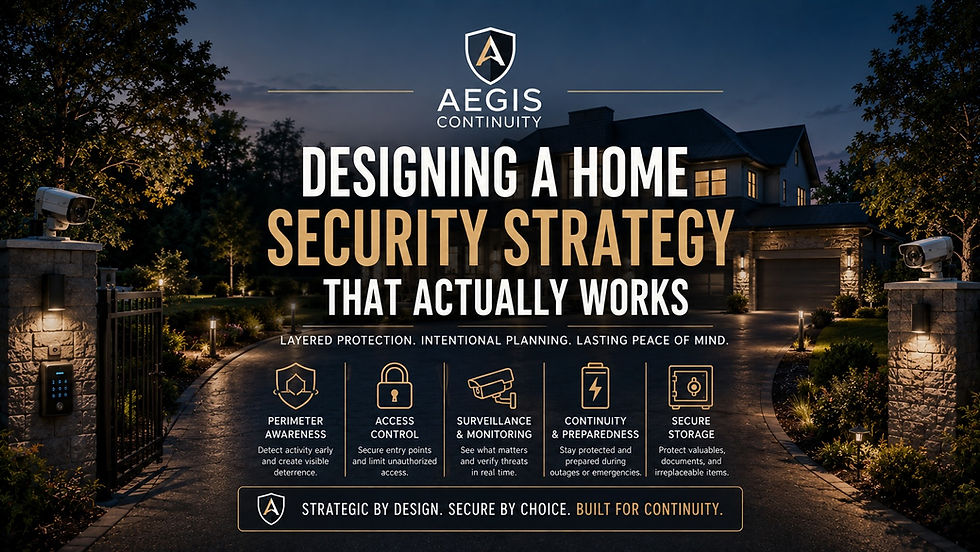
Real protection is layered, intentional, and designed around continuity — the ability for a household to remain safe, functional, and operational when something unexpected happens.
That idea sits at the center of how professionals think about security, and it is the philosophy behind everything we explore at Aegis Continuity.
Most Security Systems Are Built Around Products — Not Risk
The modern security market is crowded with devices promising peace of mind.
Smart cameras. Doorbell systems. Motion sensors. Floodlights. App-controlled locks. Wireless alarms.
Many of these tools are genuinely useful.
The problem is not the technology itself.
The problem is that most homeowners accumulate security products without understanding the vulnerabilities those products are supposed to solve.
As a result, security systems often become fragmented collections of gadgets that operate independently rather than as part of a cohesive protection strategy.
One home may have expensive cameras but poor lighting.
Another may have reinforced locks but no perimeter awareness.
A rural property may monitor the front porch while leaving detached garages, barns, gates, or long driveways effectively invisible after dark.
In many cases, homeowners unknowingly protect the least important layer of the property while leaving critical exposure points untouched.
Professional security planning works differently.
Instead of starting with devices, it starts with risk reduction.
What areas are vulnerable? Where are the access points? How early can threats be detected? What happens during a power outage? How does the household respond if systems fail?
Those questions shape the system first.
The products simply support the strategy.
Security Is About Time More Than Technology
One of the biggest misconceptions about home protection is that security systems exist to stop incidents entirely.
In reality, most effective systems are designed to create time.
Time to detect.Time to respond.Time to deter.Time to recover.
Layered protection increases the amount of effort, visibility, and uncertainty a threat encounters before reaching the home itself.
That is why perimeter awareness matters so much.
A motion light at the front door is helpful.
But a driveway alert system that detects movement hundreds of feet earlier changes the equation entirely.
A camera that records activity is useful.
But lighting, visibility, access control, and early detection working together create deterrence before escalation ever begins.
This is also why many high-end residential systems focus heavily on environmental design.
Clear sightlines. Intentional lighting placement. Controlled entry points. Predictable movement patterns. Visible deterrence.
These strategies often reduce problems before alarms are ever triggered.
The goal is not to turn a home into a fortress.
The goal is to reduce vulnerability while preserving comfort and livability.
The Most Overlooked Part of Home Protection
Many homeowners focus almost exclusively on intrusion prevention.
But continuity planning matters just as much.
What happens if the power goes out for three days?
What happens if severe weather disables communication systems?
What happens if emergency services are delayed?
Increasingly, the most resilient households are not necessarily the ones with the most expensive alarm systems.
They are the ones with layered preparedness.
Backup lighting. Battery systems. Emergency communication tools. Water storage. Surge protection. Secure document storage. Redundant access methods.
These systems are rarely glamorous.
But they are often the difference between disruption and stability during real-world emergencies.
Preparedness is not fear-driven.
It is operational.
The households that recover fastest from disruptions are usually the ones that planned before the disruption occurred.
Why “Smart” Security Sometimes Creates New Problems
Smart home technology has dramatically improved accessibility in residential security.
Wireless systems are easier to install. Monitoring is more affordable. Remote access is more convenient.
But convenience can also create fragility.
Systems dependent on internet connectivity may fail during outages.
Battery maintenance is frequently ignored.
Too many disconnected apps create notification fatigue, causing homeowners to miss genuinely important alerts.
And many households unintentionally create complicated systems that nobody else in the family understands how to operate.
A good security system should reduce stress — not create more of it.
This is why simplicity matters.
The best systems are often the ones that integrate cleanly into daily life without demanding constant attention.
Technology should support awareness, not overwhelm it.
Security That Matches the Property
Not every home requires the same protection strategy.
An apartment has different vulnerabilities than a rural property.
A suburban home faces different challenges than a multi-building acreage.
Detached garages, workshops, barns, long driveways, side gates, and delivery access points all change the way a property should be secured.
This is where generic “one-size-fits-all” security bundles often fall short.
Effective protection scales with the property itself.
For some households, that may mean simple layered lighting and reinforced entry points.
For others, it may involve long-range motion detection, perimeter alerts, integrated surveillance, backup power systems, and monitored response plans.
The goal is not excess.
The goal is appropriate coverage.
The Future of Home Protection Is Integrated Continuity
The next generation of residential security is moving away from isolated devices and toward integrated continuity systems.
Systems that combine:
perimeter awareness
access control
surveillance
backup power
environmental monitoring
emergency preparedness
secure storage
smart automation
Not because every home needs advanced technology.
But because homes increasingly function as operational centers for modern life.
People work remotely. Store sensitive records at home. Depend on connected systems. Manage deliveries, equipment, tools, and vehicles from their property.
The modern home carries more responsibility than ever before.
Protection systems need to evolve accordingly.
Final Thoughts
Real security is rarely built around fear.
It is built around stability.
The best home protection systems do not constantly remind you to feel anxious.
They quietly reduce risk in the background while supporting the normal rhythms of daily life.
That usually means fewer gimmicks.Fewer disconnected devices.Fewer impulse purchases.
And more intentional planning.
Because ultimately, the goal of security is not simply to monitor problems.
It is to help preserve continuity when life becomes unpredictable.