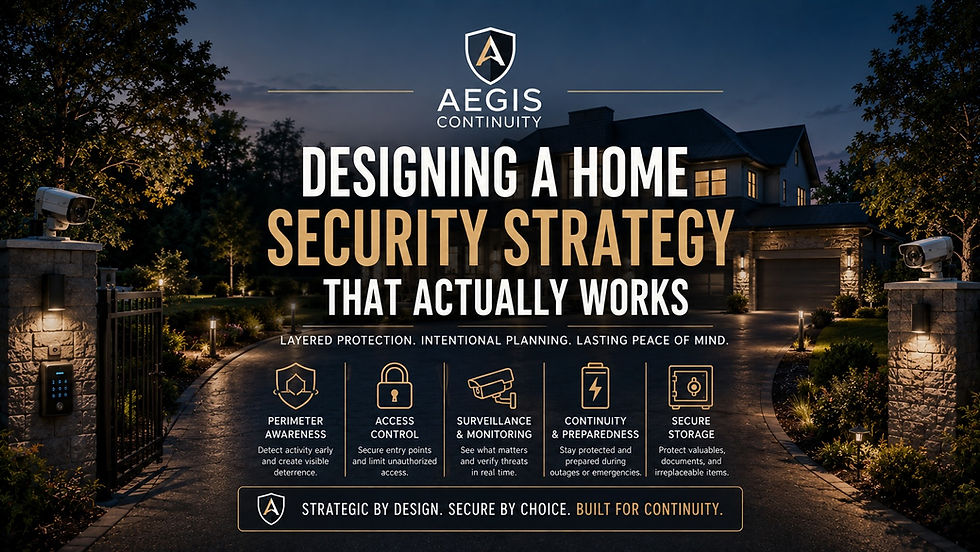
Building a Home Protection Plan That Lasts Instead of Chasing Trends
Updated: Jun 1

BEFORE YOU START
Home protection trends change constantly.
New devices appear. New features are introduced. New technologies promise greater convenience, better monitoring, or stronger security.
Some innovations provide genuine improvements.
Others quickly become outdated, replaced by the next product cycle before homeowners have fully integrated them into their routines.
The most effective protection plans often take a different approach.
Rather than focusing on the latest trend, they focus on principles that remain valuable over time: awareness, preparedness, resilience, organization, and layered protection.
Before evaluating your own security and preparedness systems, take a moment to think about what will matter years from now.
Ask yourself:
Are your current systems built around long-term needs or short-term trends?
Would your protection strategy remain effective if specific devices became obsolete?
Which parts of your preparedness plan have proven reliable over time?
Are you building a collection of products or a sustainable system?
What capabilities would remain important regardless of future technology changes?
The answers often reveal that lasting protection is rarely dependent on any single product. Instead, it comes from creating systems and habits that continue supporting the household even as technology evolves.
As you read through this guide, focus on the elements of home protection that provide enduring value. The goal is not to ignore innovation. The goal is to build a practical, adaptable protection plan that remains effective long after today's trends have changed.
Most home security systems are built around immediacy.
A new app launches. A smart gadget trends online. A camera system goes viral. A subscription platform promises “AI-powered protection.”
And homeowners respond the same way many people respond to technology marketing in general:
They add more.
More devices. More subscriptions. More notifications. More complexity.
But over time, many of those systems begin to age poorly.
Apps lose support.
Integrations fail.
Devices become obsolete.
Subscriptions increase.
Batteries degrade.
And eventually, households are left maintaining a patchwork collection of disconnected technology that no longer feels dependable.
At Aegis Continuity, we believe strong residential protection should be built differently.
Not around trends.
Around continuity.
Because ultimately, the best security systems are not the ones that feel the newest.
They are the ones that remain dependable long after the novelty fades.
Security Should Be Designed for Longevity
One of the biggest mistakes homeowners make is treating security like consumer electronics.
But home protection systems are much closer to infrastructure than entertainment technology.
A dependable lock.
Reliable perimeter lighting.
Backup power.
Strong access control.
Thoughtful surveillance placement.
These systems support the operational stability of the household itself.
And infrastructure should be designed for long-term reliability, not constant replacement cycles.
This is one reason professionally designed security systems often feel calmer and simpler than heavily trend-driven smart homes.
Professionals prioritize:
durability
maintainability
operational consistency
layered redundancy
ease of use
continuity during disruptions
The goal is not to constantly rebuild the system every two years.
The goal is stability.
Trends Often Prioritize Features Over Reliability
Many modern smart security products are marketed around feature density.
Artificial intelligence. Facial recognition. Voice integrations. Automation routines. Advanced app ecosystems.
Some of these technologies are genuinely useful.
But features are not the same thing as resilience.
And increasingly, homeowners are discovering that systems overloaded with complexity often become fragile over time.
Notifications become overwhelming.
Apps stop integrating properly.
Cloud services change pricing structures.
Firmware support disappears.
Devices require constant troubleshooting.
This creates a dangerous illusion of protection.
The system still exists, but operational trust slowly erodes.
That is why long-term protection planning should focus first on foundational reliability.
Good lighting. Strong perimeter awareness. Reliable locks. Power continuity. Dependable monitoring. Simple emergency preparedness.
Technology should support those foundations, not replace them.
The Strongest Security Systems Quietly Disappear Into Daily Life
One of the clearest signs of an effective protection system is that it does not constantly demand attention.
The household feels supported rather than overwhelmed.
Lighting functions automatically.
Access systems work consistently.
Alerts remain meaningful instead of excessive.
Preparedness systems exist quietly in the background.
This is important because systems that create too much friction eventually stop being maintained properly.
People ignore notifications.
Dead batteries go unchanged.
Automation routines break.
Devices disconnect and remain offline.
Over time, complexity itself becomes a vulnerability.
The strongest systems tend to feel calm because they are designed around sustainable daily operation rather than endless interaction.
Layered Protection Ages Better Than Gadget Accumulation
Trend-driven security planning often focuses on isolated products.
A new camera. A new smart lock. A new monitoring service.
But layered protection focuses on relationships between systems.
How perimeter lighting supports surveillance.
How access control supports deterrence.
How backup power maintains continuity during outages.
How preparedness systems reduce disruption during emergencies.
This layered approach ages far better because the system is not dependent on any single product remaining trendy or technologically dominant.
The structure remains valuable even as individual technologies evolve.
This is one reason intentional planning consistently outperforms impulsive buying.
A well-designed framework allows homeowners to upgrade thoughtfully over time without constantly rebuilding the entire system.
Preparedness Is Part of Long-Term Protection
One of the biggest misconceptions about home security is that it only involves intrusion prevention.
But continuity planning plays an equally important role in long-term residential resilience.
What happens during extended outages?
What systems continue functioning during severe weather?
How does the household respond if communication systems fail temporarily?
Backup power.
Emergency lighting.
Water storage.
Surge protection.
Secure document storage.
Preparedness systems often receive less attention because they are not flashy.
But they are some of the most durable and valuable protection investments a household can make.
Professionals understand that emergencies are rarely isolated.
Storms affect infrastructure.
Infrastructure affects communication.
Communication affects response.
Preparedness reduces cascading disruption.
That is why continuity planning sits at the center of truly resilient homes.
Good Security Evolves Slowly and Intentionally
A strong protection system is rarely built all at once.
Most resilient households evolve their systems gradually over time.
They improve perimeter lighting.
Strengthen entry points.
Add reliable surveillance.
Introduce backup systems.
Expand preparedness capabilities.
Each upgrade supports the existing structure instead of competing with it.
This creates cleaner, simpler, and more maintainable protection over the long term.
It also prevents homeowners from becoming trapped in constant upgrade cycles driven primarily by marketing pressure.
The goal is not technological perfection.
It is operational stability.
Simplicity Creates Longevity
Complex systems fail more often.
This principle appears everywhere:
Infrastructure design. Emergency planning. Aviation safety. Industrial systems management.
Residential security is no different.
Simple systems are easier to maintain.
Easier systems are more likely to remain operational.
Operational systems create real-world protection.
That does not mean homes should avoid modern technology.
It means technology should be implemented intentionally.
The best systems are usually the ones that support awareness quietly rather than demanding constant management.
Timeless protection rarely looks dramatic.
It looks dependable.
The Future of Home Protection Is Stability
As homes become increasingly connected, the households that remain safest will likely not be the ones with the greatest number of devices.
They will be the ones with the strongest continuity systems.
Reliable perimeter awareness.
Intentional access control.
Stable backup power.
Dependable monitoring.
Preparedness that reduces uncertainty.
And layered planning designed to remain useful long after trends change.
Because ultimately, home protection is not about owning the newest technology.
It is about creating systems that continue supporting stability when life becomes unpredictable.
Final Thoughts
Trends change quickly.
Good infrastructure does not.
That distinction matters enormously in residential security planning.
Because the strongest home protection systems are not built around novelty, marketing cycles, or endless upgrades.
They are built around reliability.
Awareness. Preparedness. Continuity. Durability. Intentional design.
Not because homes should feel fortified.
But because households function better when the systems protecting them are calm, dependable, and designed to last.