The Hidden Cost of Cheap Home Security Products
Updated: Jun 1

BEFORE YOU START
When it comes to home protection, the lowest purchase price is not always the lowest cost.
Security products are often compared by features, specifications, and upfront expense. Yet many of the true costs only become apparent after a system has been installed and relied upon over time.
False alerts. Unreliable connections. Poor battery life. Limited durability. Complicated interfaces. Equipment that works well during testing but becomes frustrating during everyday use.
These problems rarely appear on product packaging, but they can have a significant impact on the effectiveness of a security system.
Before evaluating your current setup, take a moment to think about the products your household depends on most.
Ask yourself:
Which security tools have consistently performed well over time?
Have you replaced devices more often than expected?
Do you trust the alerts and information your system provides?
Are your products easy for every household member to use?
Would you feel confident relying on the system during a stressful situation?
The answers often reveal that the value of a security product extends far beyond its purchase price. Reliability, durability, ease of use, and long-term performance all contribute to whether a product actually improves household protection.
As you read through this guide, focus on the long-term role security products play within a larger protection strategy. The goal is not necessarily to spend more money. The goal is to invest in tools and systems that remain dependable when they are needed most.
Cheap security products are often designed to feel reassuring long before they prove themselves reliable.
The packaging looks impressive.
The app screenshots appear sophisticated.
The feature list sounds endless:
AI detection. Cloud integration. Instant alerts. Voice assistant compatibility. Wireless installation. Smart automation.
And because modern security technology has become dramatically more affordable, homeowners often assume that adding more devices automatically creates more protection.
But over time, many people discover something frustrating.
The devices they bought for peace of mind slowly become another source of uncertainty:
Batteries die unexpectedly.
Apps stop receiving updates.
Connectivity becomes inconsistent.
False notifications multiply.
Subscriptions increase.
Systems stop integrating cleanly.
And eventually, households end up with a fragmented collection of half-maintained devices that feel more exhausting than reassuring.
The issue is not that affordable technology is inherently bad.
The issue is that reliability matters far more than most homeowners realize — especially when security systems are expected to function during stressful or unpredictable situations.
At Aegis Continuity, we believe home protection should be built around continuity and trustworthiness, not impulse-driven gadget accumulation.
Because ultimately, the true cost of a weak security system is rarely measured by the purchase price alone.
Cheap Security Often Creates Invisible Weaknesses
Many low-cost security products perform reasonably well under ideal conditions.
That is what makes them appealing.
The problems usually appear later.
During storms. Power interruptions. Connectivity disruptions. Extreme temperatures. Long-term daily use. Heavy notification loads.
This is where inexpensive systems frequently begin showing their weaknesses.
Battery-powered devices may require constant maintenance.
Wireless systems may struggle with signal consistency.
Apps may become unsupported after only a few years.
Low-cost cameras may have poor nighttime visibility or unreliable motion detection.
The homeowner often adapts slowly without realizing it.
Notifications get ignored.
One camera stays offline “temporarily.”
A dead sensor battery remains unchanged for months.
A disconnected floodlight never gets repaired.
The system still exists — but confidence in the system quietly disappears.
This is one of the most dangerous forms of security failure because it happens gradually.
People stop trusting the protection they once depended on.
Security Systems Must Function During Imperfect Conditions
A reliable home security system is not tested during perfect conditions.
It is tested during imperfect ones.
Bad weather. Unexpected outages. Stressful situations. Late-night disturbances. Internet interruptions. Emergency response delays.
This is where intentional systems dramatically outperform impulsive ones.
Professional-grade security planning prioritizes:
redundancy
durability
signal reliability
power continuity
long-term support
ease of maintenance
Because the goal is not simply to install products.
The goal is to create systems that remain operational consistently over time.
A security camera that functions perfectly 98% of the time may sound impressive until the missing 2% happens during the exact moment it was needed.
Reliability matters because emergencies rarely occur under ideal circumstances.
The Subscription Trap of Modern Security
Many modern security ecosystems appear affordable initially because the real cost arrives later.
Monthly subscriptions. Cloud storage upgrades. Premium feature unlocks. Monitoring fees. Additional device licensing.
Individually, these expenses may feel small.
But over several years, they often exceed the cost of the original equipment itself.
This does not mean subscriptions are inherently bad.
Professional monitoring and cloud systems can provide significant value when integrated thoughtfully.
The problem occurs when homeowners accumulate overlapping systems without intentional planning:
One subscription for cameras.
Another for storage.
Another for monitoring.
Another for smart lock management.
Another for automation routines.
Eventually, the household is supporting an entire ecosystem of recurring expenses without necessarily improving protection proportionally.
This is one reason the buy-fewer, better philosophy matters so much in residential security.
A smaller number of dependable systems often creates stronger long-term continuity than a sprawling collection of disconnected devices.
Complexity Creates Failure Points
One of the hidden costs of cheap security products is complexity.
Low-cost ecosystems often encourage homeowners to continuously expand with additional add-ons, sensors, integrations, and accessories.
Over time, the system becomes increasingly difficult to maintain.
Multiple apps compete for attention.
Devices update inconsistently.
Compatibility problems emerge.
Family members stop understanding how systems operate.
And during emergencies, confusion becomes its own vulnerability.
This is something professional security planners understand extremely well.
Simple systems tend to survive stress better.
Not because they are less advanced.
But because they are easier to operate consistently under pressure.
The strongest residential security systems are usually not the most technologically impressive.
They are the most operationally dependable.
False Economy Is Still Expensive
Many people choose inexpensive security products to save money.
Sometimes that decision makes sense.
But there is an important distinction between affordability and false economy.
A low-cost motion light that fails after one winter is not inexpensive if it requires replacement every year.
A weak smart lock that creates reliability concerns is not truly affordable if it compromises entry security.
A low-quality camera system that misses critical motion events may ultimately provide very little practical value regardless of price:
Durability matters.
Support matters.
Weather resistance matters.
Battery life matters.
Long-term trustworthiness matters.
The true value of a security system is measured by how reliably it supports continuity over time.
Not simply by how inexpensive it appeared during checkout.
Good Security Feels Calm
One of the clearest signs of a well-designed security system is that it quietly disappears into daily life.
The homeowner is not constantly troubleshooting.
Notifications remain meaningful rather than overwhelming.
Family members understand how systems function.
Backup systems exist without creating unnecessary complexity.
Protection feels stable instead of performative.
This is often the difference between intentional security planning and reactive gadget accumulation.
Strong systems reduce stress.
Weak systems create more of it.
And increasingly, homeowners are beginning to recognize that peace of mind is tied less to the quantity of devices and more to the reliability of the systems supporting them.
The Future of Home Protection Is Reliability
As smart technology continues evolving, the homes that remain safest will likely not be the ones with the greatest number of devices.
They will be the homes built around thoughtful integration, layered protection, and long-term continuity:
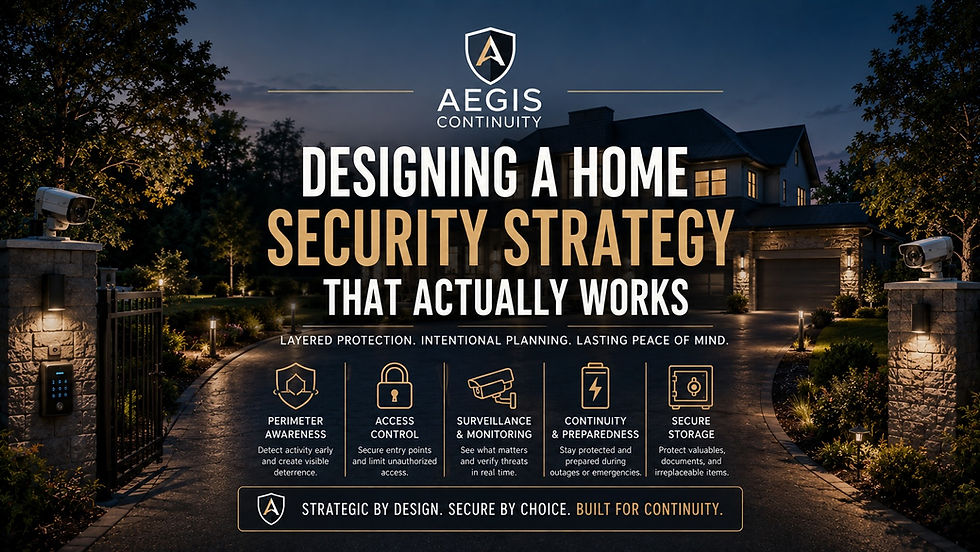
Reliable perimeter awareness.
Intentional access control.
Stable backup power.
Dependable surveillance.
Simplified monitoring.
Purpose-driven preparedness.
Not endless accumulation.
Not constant upgrading.
Not fear-driven consumption.
Just systems designed to remain functional when they are needed most.
Final Thoughts
Cheap security products rarely fail all at once.
Instead, they fail slowly.
A dead battery here. A missed notification there. A disconnected camera. An ignored update. An expired subscription.
Until eventually, the homeowner is left with the illusion of protection rather than true operational security.
That is why intentional system design matters so much.
Because real home protection is not built around novelty.
It is built around consistency.
And in the moments that matter most, reliability is often the most valuable security feature a household can own.