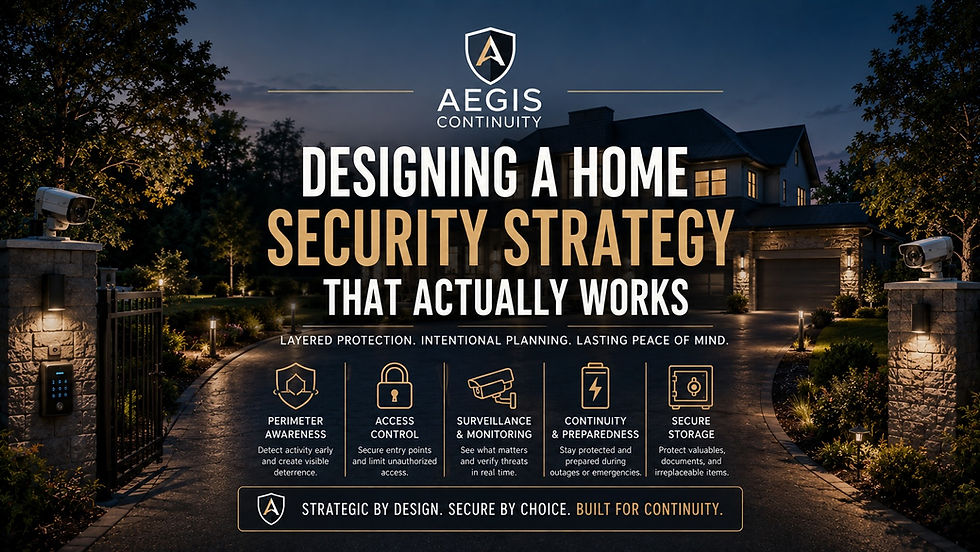
Designing a Home Security Strategy That Actually Works
Updated: Jun 1

BEFORE YOU START
Many homeowners approach security one purchase at a time.
A camera here. A motion light there. A smart lock. A sensor. A video doorbell.
Each addition may provide value, but over time it is possible to accumulate security products without ever creating a complete security strategy.
The result is often a collection of devices rather than a coordinated system.
Effective home protection works differently.
The strongest security plans are designed around layers, awareness, response, and continuity. Every component serves a purpose, and each layer supports the others.
Before evaluating your current setup, take a moment to think about how your household approaches security today.
Ask yourself:
What are you trying to protect most?
Would you know immediately if something unusual occurred on your property?
Are your security measures designed to deter, detect, delay, or respond?
Do your systems work together as part of a larger plan?
Would another family member understand how to use the system if necessary?
The answers often reveal that security is not primarily about individual products. It is about creating a strategy that supports awareness, preparedness, and informed decision-making.
As you read through this guide, focus on the principles behind effective home protection rather than any single device or technology. The goal is not simply to add more security products. The goal is to create a thoughtful, layered strategy that helps protect what matters most while remaining practical and manageable in everyday life.
Most people build home security systems the same way they build junk drawers.
One product at a time.
A camera purchased during a sale. A smart lock added after a neighborhood incident. A motion light installed after hearing about package thefts. An alarm subscription started because it “seemed like a good idea.”
Over time, the household accumulates devices without ever creating an actual strategy.
And while individual security products can certainly help, disconnected tools rarely create truly resilient protection on their own.
Real security works differently.
It is layered. Intentional. Operational. Designed around how people actually live.
At Aegis Continuity, we believe the strongest residential security systems are not built through fear-driven purchases or endless gadget accumulation.
They are built through thoughtful planning.
Because ultimately, the goal of home protection is not simply to own security products.
It is to create continuity when life becomes unpredictable.
Security Is About Reducing Vulnerability
Most homeowners think about security reactively.
How do we stop someone from getting inside the house?
But effective protection begins much earlier than the front door.
Professional security planning focuses on reducing vulnerability long before an incident escalates.
That often includes:
improving visibility
limiting hidden access points
strengthening entry locations
increasing perimeter awareness
simplifying emergency response
maintaining continuity during outages
This changes the role of security entirely.
Instead of acting only as a response mechanism, the system becomes part of the property’s overall operational design.
Good security discourages problems before alarms ever activate.
And often, the most effective security upgrades are surprisingly simple.
Strategic lighting placement.
Clear sightlines.
Intentional landscaping.
Reliable locks.
Reinforced strike plates.
Visible deterrence.
These systems rarely feel dramatic, but they quietly reduce opportunities for vulnerability every single day.
Layered Security Works Better Than Isolated Devices
One camera alone does not create meaningful protection.
Neither does a single smart lock.
Or a doorbell notification.
The strength of a security system comes from how its layers support one another.
This is one of the most important principles in residential security planning.
A layered system may include:
Perimeter Awareness
Long-range motion detection, driveway alerts, floodlights, or exterior monitoring that identifies activity before someone reaches the home itself.
Access Control
Reinforced doors, smart locks, keypad systems, and controlled entry points that reduce unauthorized access.
Surveillance
Cameras and recording systems that increase visibility and provide verification.
Continuity Planning
Backup power, surge protection, emergency communication tools, and preparedness systems that remain functional during disruptions.
Secure Storage
Safes, document protection, and responsible storage systems that preserve critical items during emergencies.
No individual layer is perfect.
But together, the layers create resilience.
This is why intentional planning matters far more than buying isolated products impulsively.
The Best Security Systems Feel Calm
One of the clearest signs of a poorly designed security system is constant friction.
Endless notifications. False alerts. Disconnected apps. Overcomplicated automation routines. Devices requiring constant troubleshooting.
Eventually, homeowners become exhausted by their own systems.
And fatigue creates vulnerability.
Notifications get ignored.
Batteries remain dead.
Alerts become background noise.
Ironically, systems designed to increase peace of mind can end up creating more stress instead.
Good security should feel almost invisible.
Reliable.
Predictable.
Integrated into everyday life without demanding constant attention.
This is why simplicity matters so much in modern residential protection.
A smaller number of dependable systems often provides more practical protection than a sprawling network of fragile technology.
Every Property Requires Different Planning
Security systems should reflect the property they are protecting.
A suburban family home has different needs than a rural acreage.
An apartment requires different strategies than a multi-building property.
Detached garages, side gates, workshops, barns, long driveways, and delivery access points all change how vulnerabilities should be addressed.
This is where many generic security bundles fall short.
They assume every household operates the same way.
But thoughtful planning considers:
property layout
daily routines
visibility limitations
environmental conditions
household size
delivery patterns
travel frequency
emergency response access
The strongest systems adapt to the realities of the property itself rather than forcing households into one-size-fits-all solutions.
Continuity Matters More Than Fear
Much of the security industry is built around fear-based marketing.
Worst-case scenarios.
Constant threat reminders.
Aggressive surveillance messaging.
But households that focus exclusively on fear often end up making reactive decisions instead of strategic ones.
The most resilient homes are usually built around continuity.
What systems continue functioning during outages?
What happens during severe weather?
How quickly can the household recover from disruptions?
How easy is the system to maintain long term?
Preparedness is not paranoia.
It is operational stability.
A reliable home security strategy supports daily life quietly in the background while remaining capable during moments of stress or disruption.
That philosophy creates calmer, stronger systems.
Technology Should Support Awareness — Not Replace It
Modern smart home technology has made security dramatically more accessible.
Wireless cameras.
Remote monitoring.
Smart locks.
Integrated automation.
These tools can provide tremendous value when used intentionally.
But technology alone does not create safety.
Awareness still matters.
Lighting still matters.
Visibility still matters.
Good habits still matter.
The strongest homes combine thoughtful environmental design with dependable technology layers.
Not because every property needs advanced systems.
But because protection works best when technology supports human awareness instead of replacing it entirely.
Strong Systems Are Built Slowly
One of the biggest misconceptions about residential security is that everything needs to be solved immediately.
In reality, most effective systems are built gradually over time.
A household may begin with:
better perimeter lighting
reinforced entry hardware
reliable locks
a single camera system
emergency preparedness basics
Then expand thoughtfully as needs evolve.
This approach often creates stronger systems because each upgrade is added intentionally instead of impulsively.
The result is usually cleaner, simpler, and more sustainable long term.
Final Thoughts
A strong home security strategy is not built around fear.
It is built around clarity.
Understanding vulnerabilities. Reducing unnecessary exposure. Improving awareness. Supporting continuity. And creating systems that remain dependable over time.
Because ultimately, the goal of home protection is not to create a fortress.
It is to create a home that remains stable, functional, and resilient when life becomes unpredictable.