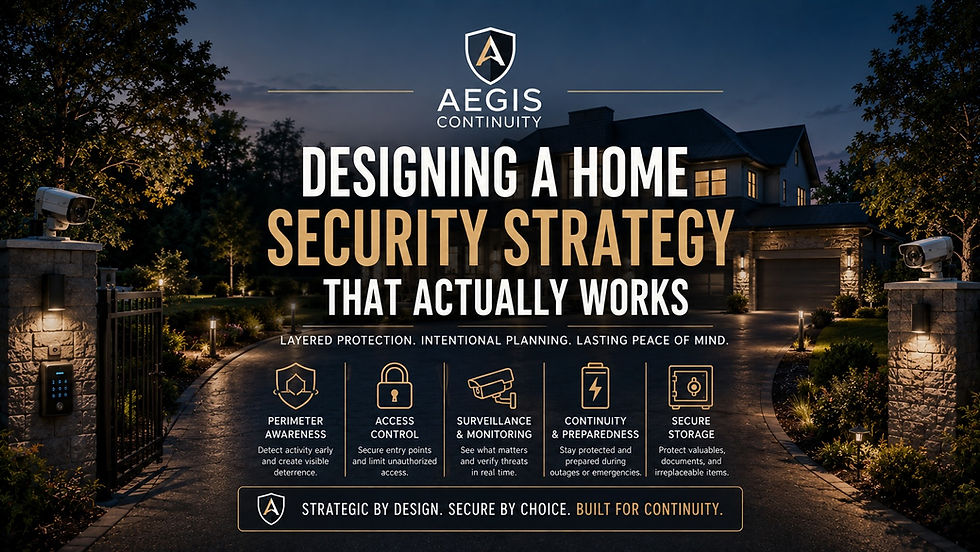
The Buy-Fewer, Better Philosophy Behind a Functional Home Security System
Updated: Jun 1

BEFORE YOU START
It is surprisingly easy to accumulate security products.
A video doorbell. A few cameras. Motion lights. Sensors. Smart locks. Alarms.
Monitoring devices.
Each purchase may solve a specific problem, but over time many homeowners find themselves managing a growing collection of products that do not necessarily create a stronger security system.
More equipment does not always mean better protection.
In fact, complexity can sometimes become its own vulnerability. Too many devices, too many notifications, and too many disconnected systems can make it harder to identify what truly matters.
The most effective home protection strategies often follow a different philosophy.
Instead of acquiring more, they focus on selecting fewer tools that perform reliably, integrate well, and support a clear security plan.
Before evaluating your current setup, take a moment to think about what actually contributes to your household's security.
Ask yourself:
Which devices provide the most meaningful protection?
Are there products you rarely use or pay attention to?
Do your systems work together effectively?
Are notifications and alerts helpful or overwhelming?
Would fewer, higher-quality components create a simpler and more dependable system?
The answers often reveal that effective security is not determined by the number of devices installed. It is determined by how well those devices support awareness, preparedness, and response.
As you read through this guide, focus on the value of thoughtful selection rather than accumulation. The goal is not to build the largest security system possible. The goal is to create a dependable, manageable system that protects what matters most without adding unnecessary complexity.
There is a point where adding more security products stops making a home safer.
Most homeowners never realize when they cross that line.
The modern security industry encourages constant expansion: More cameras. More sensors. More alerts. More subscriptions. More apps. More devices connected to more devices.
And while many of these tools are genuinely useful, the result is often a home protection system that feels fragmented, complicated, and exhausting to maintain.
Ironically, systems built around excess frequently become less reliable over time.
Notifications are ignored.Batteries go unchanged. Apps become cluttered.Family members stop understanding how the system works. Critical vulnerabilities get buried beneath layers of unnecessary technology.
The problem is not that people care too much about security.
The problem is that many households approach protection as accumulation rather than intentional design.
At Aegis Continuity, we believe the strongest systems are rarely the ones with the most equipment.
They are the ones built with clarity.
Security Should Reduce Friction — Not Create It
A well-designed security system should integrate quietly into daily life.
It should support awareness without creating anxiety.
It should simplify response, not overwhelm the homeowner with constant interruptions.
Unfortunately, many modern systems do the opposite.
A household may have:
three separate security apps
disconnected smart devices
overlapping camera systems
redundant subscriptions
motion alerts triggering every few minutes
devices that require constant charging or troubleshooting
Instead of feeling protected, homeowners feel responsible for managing a complicated technology ecosystem.
Over time, fatigue sets in.
Alerts become background noise.
Maintenance gets delayed.
The system gradually loses effectiveness — not because the products themselves are bad, but because complexity becomes difficult to sustain.
This is why intentional security planning matters so much.
The goal is not maximum technology.
The goal is sustainable protection.
Professional Security Planning Starts With Priorities
One of the biggest differences between consumer-focused security marketing and professional security planning is the way priorities are established.
Consumer marketing often sells fear.
Professional planning focuses on probability, vulnerability, and continuity.
That distinction matters.
Most homes do not require commercial-grade surveillance systems or dozens of connected devices.
But almost every home benefits from:
better exterior lighting
reinforced access points
layered perimeter awareness
backup power planning
simplified monitoring
secure document storage
intentional entry control
These foundational systems often provide more real-world protection than expensive upgrades purchased impulsively.
Professionals typically ask different questions than consumers ask themselves.
What are the property’s most vulnerable access points?
How early can unusual activity be detected?
What systems continue functioning during outages?
What failures would create the greatest disruption?
What solutions are easiest for the household to maintain consistently?
These questions lead to simpler, stronger systems.
Reliability Is More Important Than Features
One reliable motion sensor is more valuable than five devices that constantly malfunction.
One well-positioned camera is often more useful than an entire system with blind spots and poor visibility.
One dependable backup battery matters more than a collection of disconnected emergency gadgets that nobody checks until the power goes out.
This is the hidden weakness of many low-cost security ecosystems.
They prioritize feature lists over reliability.
Consumers are sold on:
app integrations
cloud features
AI detection labels
automation routines
voice assistant compatibility
But the systems that actually matter during emergencies are usually the ones that continue functioning quietly and consistently over long periods of time.
Durability matters.
Battery life matters.
Ease of maintenance matters.
Signal reliability matters.
Power redundancy matters.
A good system does not need to feel impressive every day.
It needs to work on the day it actually matters.
Layered Security Works Better Than Reactive Security
Many homeowners think about security almost entirely in terms of reaction.
An alarm sounds after entry. A notification appears after movement occurs. A camera records after someone approaches the property.
Layered security changes the timeline.
Instead of focusing only on response, it creates multiple opportunities for awareness and deterrence before escalation occurs.
For example:
A long driveway alert detects movement early.
Exterior lighting increases visibility.
Reinforced entry points increase resistance.
Visible cameras increase uncertainty.
Smart locks reduce access vulnerabilities.
Backup power maintains continuity during outages.
No single product creates security on its own.
The strength comes from how the layers support one another.
This is why the buy-fewer, better philosophy works so effectively.
When every component serves a meaningful role, the system becomes stronger without becoming overwhelming.
The Hidden Cost of Cheap Security Products
Low-cost devices are often marketed as affordable protection.
But over time, poorly built systems can become surprisingly expensive.
Frequent replacements. Subscription creep. Battery inefficiency. Connectivity failures. False alerts. App abandonment.
Many households slowly accumulate a drawer full of unused security gadgets that once seemed essential.
The issue is not always the upfront price.
It is long-term trustworthiness.
A dependable system reduces friction over time.
A poor system increases maintenance, frustration, and uncertainty.
That is why many professional-grade products emphasize stability and longevity rather than constant feature expansion.
The goal is not endless upgrading.
The goal is continuity.
Security Should Match the Household
Not every property requires the same level of complexity.
A suburban family home has different needs than a rural property with outbuildings.
An apartment requires different protection strategies than a multi-acre property.
The strongest systems are tailored to actual household patterns.
How people enter and leave the home. How packages are delivered. Whether children are present. Whether elderly family members live on-site. How often the property sits vacant.
Security becomes far more effective when it supports the rhythms of real life instead of interrupting them.
This is another reason why fewer, better systems often outperform larger collections of disconnected technology.
Thoughtful placement and intentional coverage matter more than quantity.
Simplicity Creates Better Long-Term Protection
Simple systems are easier to maintain.
Easier systems are more likely to remain operational.
Operational systems create real-world protection.
This principle appears repeatedly across emergency preparedness, infrastructure design, aviation safety, and professional risk management.
Complexity increases failure points.
Simplicity improves resilience.
That does not mean modern technology is bad.
In many cases, smart systems dramatically improve awareness and convenience.
But the best technology is usually the technology that quietly supports stability rather than demanding constant attention.
A truly effective home security system often feels calm.
Predictable.
Integrated.
Reliable.
Not performative.
Final Thoughts
The future of residential security is not about filling homes with more devices.
It is about building smarter systems with greater intentionality.
Fewer weak points. Fewer unnecessary complications. Fewer disconnected products competing for attention.
And more thoughtful protection layers designed around how people actually live.
Because ultimately, the goal of home security is not simply to own more technology.
It is to create an environment where households remain safer, more stable, and more resilient when life becomes unpredictable.